Blue background graphic displaying a red biohazard sharps container marked with a green checkmark, beside an image of a loose needle in garbage marked with a red X. Text reads “IMPORTANT! Sharps and needles are NOT accepted.”

Sharps Are NOT Accepted

This needle was recently found in Victoria County’s recycling stream

To some people, it may seem small but to the staff sorting our materials, it represents a very serious hazard. 

When sharps are placed in garbage or recycling bags, workers can be accidentally pricked while collecting or sorting materials. A single needle-stick injury can result in months of stress, medical appointments, bloodwork, and up to a year of testing to determine whether diseases or infections were transmitted.

Our staff deserve to return home safely to their families every day. 

Sharps are NOT accepted through municipal waste collection or at any of our waste or recycling facilities. 

This includes: 

  • Needles 
  • Syringes 
  • Lancets 
  • Pen needles 
  • Auto-injectors and similar medical sharps 

Sharps should ALWAYS be placed in an approved sharps container and returned to a pharmacy for safe disposal. 

Sharps containers are available through pharmacies, although Nova Scotia is currently experiencing a temporary sharps container shortage. Even during this shortage, sharps should NEVER be placed in household garbage or recycling. Please speak with your pharmacy for guidance on safe temporary storage and disposal options. 

Together, we can help protect waste collection and recycling staff, facility workers, and the public by disposing sharps safely.  

To learn more about proper sharps disposal, visit: https://pans.ns.ca/sharps-disposal-program/  

RESOURCES 

Victoria County logo above the text “Municipal Update – Waste and Recycling” on a blue and white background.

Municipality no longer accepting textiles for recycling 

Textiles and clothing are no longer being accepted at municipal waste management facilities until further notice. 

Our textile recycling partner has suspended collections because they have accumulated more material than they can currently process and market. As a result, the Municipality is unable to accept clothing and other textiles through the program at this time. 

Residents are encouraged to consider alternative options for unwanted textiles, including: 

  • Donating usable clothing and household textiles to local second-hand stores. 
  • Using clothing donation bins. 
  • Giving items directly to local charities and community organizations where appropriate. 

The Municipality will notify residents if textile recycling services resume in the future. 

For information about textile diversion and reuse options, visit Divert NS: https://divertns.ca/textiles 

Thank you for your understanding and for continuing to support waste reduction and reuse efforts. 

Yellow municipal notice stating garbage was not collected. Large heading reads “Why Was My Garbage Left Behind?” and “REJECTED.” Checklist lists reasons such as untied bags, wrong bag colors, or overweight bundles. Includes limits for bags, cardboard bundles, and privacy bag rules. Contact details and “Victoria County” logo shown at the bottom.

Why Was My Garbage Left Behind? 

Sometimes, waste set out at the curb isn’t collected and when that happens, you’ll see a rejection tag left behind. These tags are there to help residents understand what needs to be corrected so materials can be picked up on the next collection day. 

Here are the most common reasons waste may not be collected: 

1. Bags must be tied 
Untied bags can spill or create safety issues for collection staff. Make sure all bags are securely tied. 

2. Black bags are not accepted 
Garbage must be set out in clear bags.  

3. Incorrect sorting 

  • Garbage or organics in blue bags will not be collected.  
  • Recyclables or organics placed in clear garbage bags will also be rejected. 

Sorting materials correctly ensures waste goes to the right place.  

4. Bags or bundles are too heavy 
Each bag or cardboard bundle must weigh less than 23 kg (50 lbs).  

5. Privacy bag limit exceeded 
Only one privacy bag (a non-clear bag for sensitive items) is allowed per clear garbage bag. 

6. Bag limits exceeded 
There is a limit of 4 bags for clear garbage and organics and a limit of 6 bags for recycling.  Exceeding these limit means extra bags won’t be collected. 

7. Cardboard limits exceeded 
Cardboard must be tied in bundles, with a maximum of 2 bundles, each no larger than 1 ft x 2 ft x 3 ft. 

What to Do Next 

If your waste is tagged: 

  • Review the reason listed on the tag  
  • Correct the issue (re-sort, re-bag, reduce weight, etc.)  
  • Set it out again on your next collection day  

Following these guidelines helps keep collection running smoothly, protects workers and ensures materials are properly sorted and processed. Use the Victoria County Waste Sorting Guide as a reference.  

Graphic titled “Solid Waste Collection” showing a pile of construction debris, electronic waste, tires, paint, battery, and containers, with text “Items not accepted at the curb” on a dark blue background.

Waste Disposal: Items Not Accepted at the Curb 

Some materials are not accepted through curbside collection and must be taken to a transfer station or recycling depot. 

Transfer Station Disposal 

The following items must be taken to a transfer station: 

  • Bulky items or large loads of waste  
  • Construction and demolition debris  
  • Scrap metal and appliances  
  • Yard waste (no rocks, soil, or branches larger than 2.5 cm / 1 inch)  
  • Motor oil and antifreeze  
  • Passenger tires (off-rim, under 24.5”)  
  • Used cooking oil  

Recycling Depot Disposal 

The following items are accepted at designated recycling depots: 

  • Refundable beverage containers  
  • Clothing and textiles  
  • Batteries  
  • Electronics  
  • Paint and aerosol containers (empty)  
  • Flexible plastics and foam packaging  

Placing these items at the curb may result in rejected waste

For guidance on how to properly sort waste for curbside collection refer to the Victoria County Waste Sorting Guide.  

For information about waste sorting compliance and rejected materials: 

Kweku Attafuah-Wadee  
Manager of Solid Waste Collections  
(902) 294-0269 
Kweku.Attafuah-Wadee@VictoriaCounty.ca 

For information about waste sorting rules and resources: 

Morgan MacInnis 
Solid Waste Educator 
Phone: 902-295-0591 
morgan.macinnis@victoriacounty.ca 

Related Links 

Victoria County promotional poster with a blue sky and clouds above green hills. At the top is the Victoria County logo and the tagline “Naturally Connected.” Text reads: “Kits available at the Baddeck and Ingonish libraries.” An illustrated person stands on the grass holding a litter picker and a garbage bag. Large text at the bottom reads: “Cleaning Up Our Communities.”

Cleaning Up Our Communities: Litter Kits Now Available

Many hands make light work—now it’s easier than ever for residents to get involved in keeping our communities litter-free.

To support local clean-up efforts, litter kits are now available for pickup at two locations:

Residents can drop by during regular library hours to pick up a kit and start making a difference right away.

What’s Inside a Litter Kit?

Each kit includes the essentials needed for a safe and effective clean-up:

Whether you’re heading out for a walk, spending time outdoors with family, or organizing a small group clean-up, these kits provide everything you need to get started.

Supporting Community Action

This initiative is designed to:

  • Encourage community involvement in keeping our public spaces clean
  • Make participation easy and accessible for residents
  • Support environmental data collection through the Great Nova Scotia Pick-Me-Up program

Every bag of litter collected contributes to a cleaner, healthier environment—and helps build a stronger sense of community pride.

Need Additional Supplies?

If you’re planning a larger clean-up or simply need more materials, additional gloves and bags are available. Residents can contact their local Councillor to request extra supplies.

Join the Effort

Small actions add up to big impacts. By taking part in this program, you’re helping to protect the natural beauty of Victoria County for everyone to enjoy.

Pick up a litter kit, head outside, and be part of keeping our communities clean and beautiful.

Related Links:

Close-up image of empty plastic bottles and containers in soft focus, with bold overlaid text that reads “Sorting Your Waste” at the top and “WHAT GOES WHERE” in large blue, black, and green letters across the center of the image.

Sorting Your Waste: What Goes Where? 

Sort your waste materials before placing them curbside to make sure they are collected and processed correctly. 

Garbage (Clear Bags) 

For non-recyclable, non-compostable waste only. 

Do not include: 

  • Food or food scraps (bread, meat, coffee grounds, eggshells)  
  • Recyclable materials (paper, cardboard, plastics, glass, cans)  
  • Hazardous items like batteries  

Recycling (Blue Bags) 

For clean, accepted recyclable materials. 

Do not include: 

  • Food or food-soiled items  
  • Personal care items  
  • Pet waste  
  • Household garbage like soiled paper towels, coffee pods, broken glass 

Organics (Clear Green-Tinted Bags) 

For food scraps and compostable materials. 

Do not include: 

  • Recyclables like plastics, packaging or containers  
  • Personal care items  
  • Pet waste  
  • Household garbage like coffee pods  

Need help sorting? 

If you are unsure where an item belongs: 

For information about waste sorting compliance and rejected materials: 

Kweku Attafuah-Wadee  
Manager of Solid Waste Collections  
(902) 294-0269 
Kweku.Attafuah-Wadee@VictoriaCounty.ca 

For information about waste sorting rules and resources: 

Morgan MacInnis  
Solid Waste Educator 
Phone: 902-295-0591 
morgan.macinnis@victoriacounty.ca 

Related Links 

Close-up outdoor scene of a compost pile. In the foreground, a pair of bare hands holds a mound of dark, crumbly soil. Around the pile are visible food scraps including cracked brown eggshells, vegetable peels, and bits of organic waste scattered on the ground. Overlaid on the upper center of the image is a green speech-bubble-shaped banner with white text that reads, “Compost 101: From Scraps to Gold.” At the bottom left, a blue rectangle contains black text that reads, “FREE WEBINAR: MAY 29.” The background shows earthy soil and decomposing organic material, emphasizing the composting process.

Composting 101: From Scraps to Gold 

Ever wondered what happens to your food scraps after they leave your kitchen? Join our Solid Waste Educator for a fun and informative virtual webinar all about composting and how small changes at home can make a big difference! 

Date: May 29
Time: 2:00 p.m.
Format: 30-minute virtual presentation + time for questions afterwards

During this webinar, we’ll cover:
– What composting is and why it’s so important
– How curbside organics collection works in Victoria County
– Easy ways to compost at home, including backyard composting and vermicomposting

✨Everyone who pre-registers will be entered into a draw for a chance to WIN a composter — with TWO composters up for grabs!

Whether you’re brand new to composting or looking to improve your current setup, this session is a great place to start.

Pre-register here: https://victoriacounty.com/form-library/webinar-event-registration-form/

Turn your scraps into gold and join the composting conversation! 

Join the Webinar:

Join: https://teams.microsoft.com/meet/284740035219553?p=EUgf13a5PhsAnAQL3q

Meeting ID: 284 740 035 219 553

Passcode: Bh9jx6zX

Large outdoor compost pile at the Baddeck Waste Management Facility, with food scraps and organic material in the foreground, a small utility building and truck in the background, and trees under a blue sky. White text at the top reads, “It’s Compost Awareness Week,” and black text at the bottom reads, “Compost pile at the Baddeck Waste Management Facility.”

Victoria County Celebrates Compost Awareness Week

This Compost Awareness Week, we’re encouraging all residents to take a closer look at what goes into their green bags and what should stay out of Nova Scotia’s landfills.

We’ve noticed a drop in the amount of organics being collected curbside, and this is a great opportunity to remind everyone just how important composting is for our community here in Victoria County.

Did you know?

Each household is allocated 4 translucent green bags of organics per week through our curbside collection program. These bags help keep food scraps and compostable materials out of landfills where they don’t belong.

Helpful tip: We recommend using regular green translucent bags instead of “compostable” bags, as they often rip on route and don’t break down well in our composting system.

Why it matters

Organic waste is the largest material stream in Nova Scotia landfills. When food waste and other organics end up there instead of being composted, it creates serious issues:

  • When organic waste breaks down without oxygen in a landfill, it produces methane, a powerful greenhouse gas that contributes to climate change
  • It takes up valuable landfill space
  • It wastes nutrients that could otherwise be returned to the soil through composting

The good news

When we compost properly, we turn food scraps and organics into useful, nutrient-rich material that supports healthier soil and a more sustainable future for Victoria County.

Small actions make a big difference. By taking advantage of our curbside organics collection each week, you’re helping reduce emissions, extend the life of our landfill and protect the environment we all share.

Let’s work together this Compost Awareness Week to keep organics out of the landfill and returned back to the earth where they belong.

Related Links

Portrait-style image of a person centered in front of illustrated panels showing people caring for nature, recycling, and holding the Earth, with green and blue outdoor scenes in the background. A teal banner at the bottom contains the text, “Meet your Solid Waste Educator!”

Meet Your Solid Waste Educator 

Victoria County now has a dedicated Solid Waste Educator to help residents, schools, businesses, and community groups better understand waste, improve recycling and composting, and take action to reduce what we send to the landfill. 

Whether you’re a teacher, business owner, volunteer, or resident with a question, this service is here to support you. 

What’s Available 

For Schools  

Bring waste education to life with interactive, curriculum-connected learning: 

  • Classroom presentations tailored by grade level  
  • Topics include recycling, composting, climate change, food waste, textile waste and ocean plastics  
  • Hands-on waste audits that can connect to math and data learning  
  • Tours of local waste management sites to see how waste is sorted and transported  

For Community Groups 

Planning a clean-up or looking to reduce waste in your community? 

  • Presentations on proper sorting, recycling and composting  
  • Support for organizing community clean-ups  
  • Help accessing supplies like bags and gloves  
  • Guidance on how to sort and dispose of collected waste  

For Businesses  

Simple changes can make a big difference: 

  • Learn about recent recycling changes in Nova Scotia  
  • Improve sorting practices  
  • Reduce disposal costs through better waste diversion  
  • Book a waste audit to identify areas for improvement  

How can a waste audit help you?  

Not sure how you’re doing? A waste audit can help: 

  • Identify what’s going in the garbage that shouldn’t be  
  • Highlight opportunities to improve recycling and composting  
  • Provide clear, practical recommendations  

Need Help or Have Questions? 

If you’re unsure about sorting rules, changes to recycling or how to reduce waste, you can reach out anytime. 

Book a presentation, tour, audit or clean-up support today. 

Contact: 

Morgan MacInnis
Solid Waste Education
Email: morgan.macinnis@victoriacounty.ca  
Phone: (902)-295-0591 

Related Links 

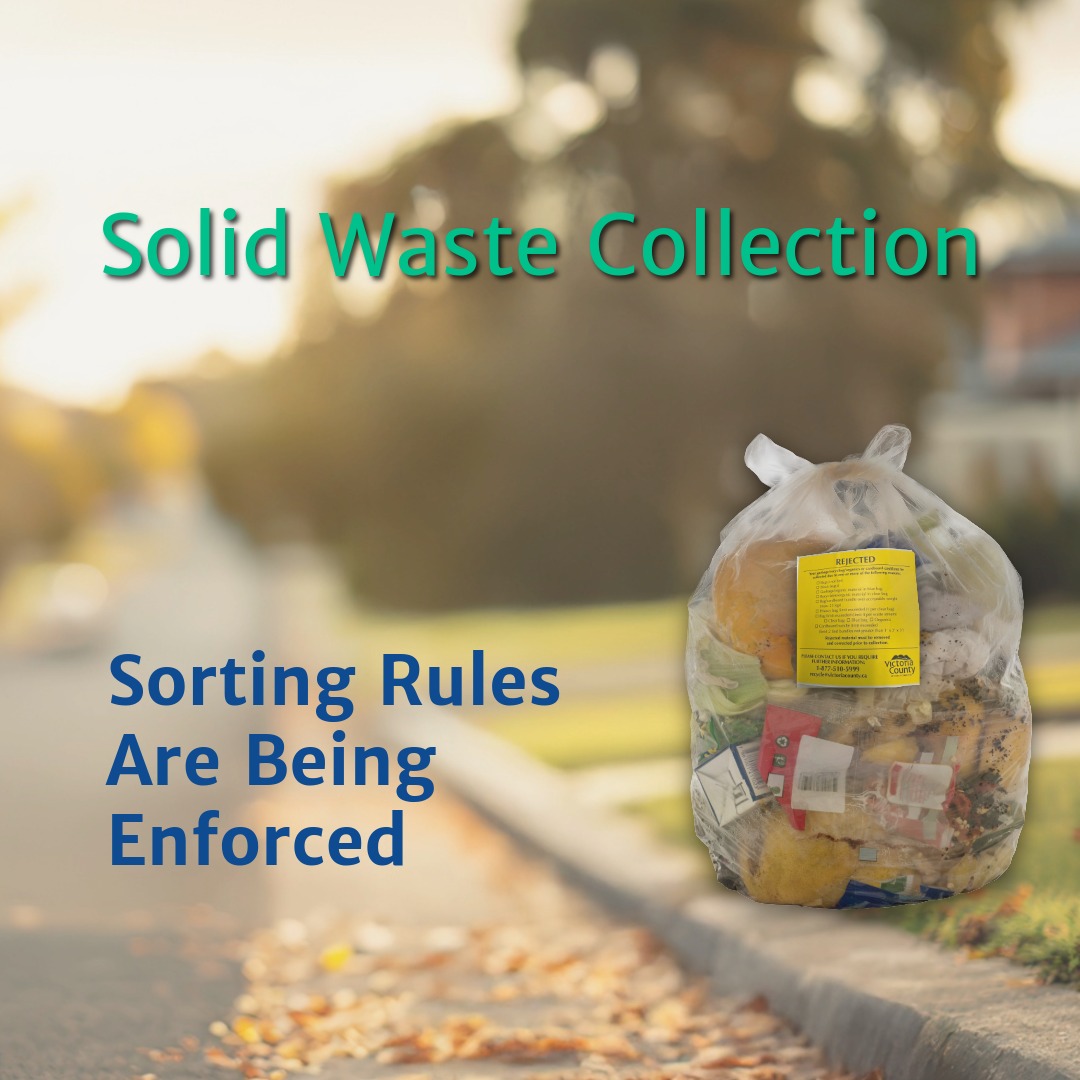
Graphic showing a clear garbage bag placed at a curbside with a yellow “Rejected” tag attached, containing mixed waste. Text reads “Solid Waste Collection” and “Sorting Rules Are Being Enforced,” set against a blurred residential street and trees in the background.

Curbside Waste Collection: Sorting Rules Are Being Enforced 

Victoria County is reminding residents and businesses that curbside waste must be properly sorted in accordance with the Solid Waste Collection and Disposal By-law

Waste collection crews have been directed to reject bags that do not meet sorting requirements. 

A bag will be rejected if it contains items that do not belong in that waste stream. 

What this means 

  • Garbage (clear bags), recycling (blue bags), and organics (clear green-tinted bags) must contain only accepted materials  
  • Bags containing non-accepted items will be left behind  

Examples include: 

  • Garbage bags containing food scraps or recyclables  
  • Recycling bags containing food, pet waste or household garbage  
  • Organics bags containing plastics or non-compostable materials  

Use the waste sorting guide 

When in doubt, check first. Avoid rejection by reviewing accepted materials before placing items curbside.  

The Recycle Cape Breton app is also available and includes a Waste Wizard tool to help determine proper disposal. Download the app on Google Play or the App Store

For information about waste sorting compliance and rejected materials: 

Kweku Attafuah-Wadee  
Manager of Solid Waste Collections  
(902) 294-0269 
Kweku.Attafuah-Wadee@VictoriaCounty.ca 

For information about waste sorting rules and resources: 

Morgan MacInnis  
Solid Waste Educator 
Phone: 902-295-0591 
morgan.macinnis@victoriacounty.ca 

Related Links